

How to Use AI in Product Development?
How to Use AI in Product Development?

Revolutionizing Product Development
Artificial Intelligence (AI) has emerged as a transformative force in product development, offering innovative ways to design, test, and improve products across industries. Leveraging AI in product development can lead to faster iterations, cost reductions, and enhanced product quality. However, successfully incorporating AI requires a thoughtful approach to balance tradeoffs, navigate challenges, and maximize its impact on the development process. This article provides a comprehensive analysis of how AI influences product development and offers insights into its best practices.
Key Factors Impacting Product Development when using AI
1. Automation and Efficiency
AI-powered tools can automate repetitive and time-consuming tasks such as data analysis, prototyping, and quality assurance. By reducing human effort in these areas, teams can focus on higher-level creative and strategic tasks.
Tradeoff: Automation requires significant upfront investment in AI technologies and training. There is also a risk of over-automation, which can stifle creativity or miss nuanced aspects of human judgment.
2. Data Utilization
AI thrives on data. During product development, it can analyze market trends, customer preferences, and historical performance data to inform design decisions. For instance, AI can predict which features are most likely to resonate with target audiences.
Challenge: Ensuring access to high-quality, unbiased data is critical. Poor data can lead to inaccurate insights and suboptimal product features.
3. Personalization
AI enables hyper-personalized product designs and recommendations. For example, in software products, AI can create user interfaces tailored to individual preferences.
Tradeoff: Personalization requires careful balancing of user privacy and data collection practices. Transparency and ethical considerations are paramount to maintaining consumer trust.
4. Speed of Innovation
AI development services can expedite the product development lifecycle through rapid prototyping, virtual simulations, and iterative testing. Machine learning models can identify flaws or inefficiencies in designs before physical prototypes are built.
Challenge: While AI accelerates innovation, it also demands constant updates to algorithms and models, which can strain resources.
Learn How AI has helped develop and empower SMEs.
Challenges in Adopting AI for Software Development

1. Integration with Existing Processes
Incorporating AI into legacy product development workflows can be challenging. Teams need to re-engineer processes and ensure compatibility with existing tools and methodologies.
2. Skill Gaps
AI requires specialized expertise, including data science, machine learning, and AI ethics. Organizations often struggle to upskill their workforce or recruit talent with these competencies.
3. Ethical and Legal Considerations
AI applications in product development raise concerns about intellectual property, bias, and accountability. For example, who is responsible for design flaws when an AI-driven system generates them?
4. Cost Implications
AI implementation can be expensive, especially for small and medium-sized enterprises. Developing and maintaining AI systems involves costs for software, infrastructure, and skilled personnel.
Learn why AI is important in MVP development.
Impact of AI on Decision-Making
AI’s influence on decision-making in product development is profound. By providing data-driven insights, AI reduces the reliance on intuition and helps teams make informed choices. However, over-reliance on AI could overshadow human creativity and innovation. Striking a balance between AI-driven and human-led decisions is crucial to achieving optimal outcomes.
A notable statistic from PwC indicates that enterprises proficient in AI and machine learning—termed “Digital Champions”—generate over 30% of their revenues from fully digital products or services, highlighting the significant impact of AI on business outcomes in product development
Learn How AI has impacted startups.
Best Practices for Using AI in Product Development
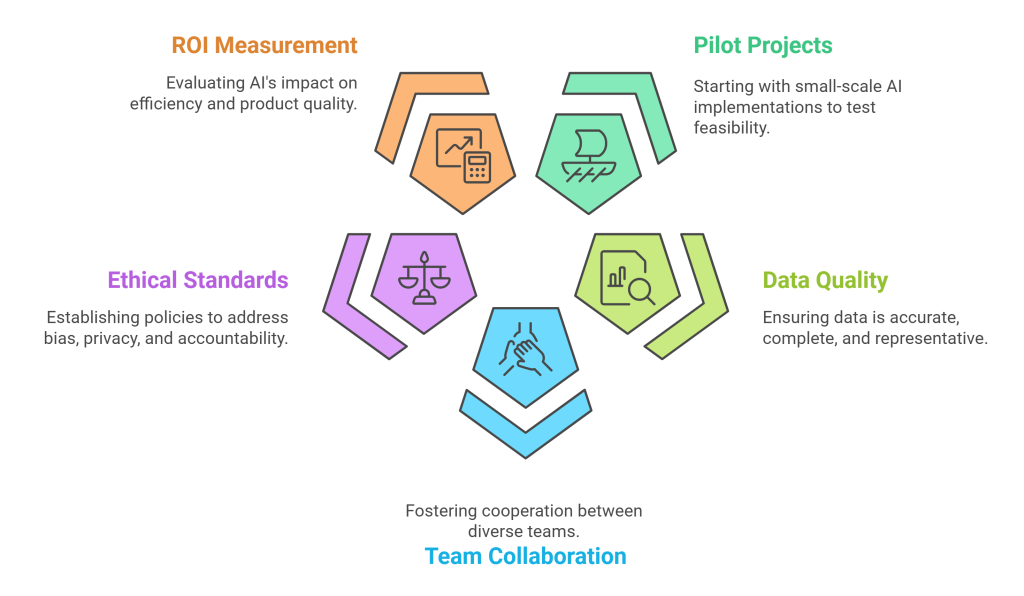
- Start Small: Begin with pilot projects to test AI applications in specific stages of development, such as testing or data analysis.
- Focus on Data Quality: Invest in data governance practices to ensure the data used is accurate, complete, and representative.
- Collaborate Across Teams: Encourage collaboration between data scientists, engineers, and designers to bridge technical and creative aspects.
- Prioritize Ethics: Develop an AI ethics policy to address concerns about bias, privacy, and accountability.
- Measure ROI: Continuously evaluate the impact of AI on efficiency, cost savings, and product quality to refine strategies.
Learn how AI in mobile applications can create a revolution.
Conclusion
AI offers immense potential to revolutionize product development by enhancing efficiency, enabling personalization, and expediting innovation. However, its successful adoption requires careful consideration of tradeoffs, challenges, and ethical implications. By prioritizing data quality, fostering collaboration, and maintaining a balance between automation and human creativity, organizations can harness AI’s full potential. As AI technologies continue to evolve, staying informed and adaptable will be essential to remaining competitive in the ever-changing landscape of product development.

Related articles

How AI Improves User Experience in Apps?
Artificial Intelligence (AI) in User Experience (UX) Artificial Intelligence (AI) is revolutionizing industries across the globe, but its transformative impact...

The Real Cost of Hiring a Web Developer: Unveiling the Mystery Behind Web Development Pricing
Have you ever wondered why hiring a web developer sometimes feels like trying to decipher an ancient scroll written in...

Trends Shaping Freelance Web Design in 2024
As we move further into 2024, several trends are influencing the freelance web design landscape: Mobile-First Design With mobile devices...

Ready to Ship Your Vibe Coded App?
You've already done the hard part — validating your idea and building something that works. Let's turn it into a product your users can trust and your business can scale.