

Unpacking Neural Networks: Are They Part of Deep Learning?
Unpacking Neural Networks: Are They Part of Deep Learning?

Are Neural Networks Part of Deep Learning?
Artificial intelligence (AI) has transformed industries and everyday life, and at the core of this revolution are neural networks and deep learning. But what exactly is the connection between these two? Are neural networks part of deep learning, or do they stand alone? This article explores the relationship between neural networks and deep learning, answering the question, “Are neural networks part of deep learning?” while highlighting their differences and how they work together to drive AI innovation.
What Are Neural Networks?
Neural networks are the backbone of many AI systems. They are computational models inspired by the human brain, designed to recognize patterns and make decisions based on input data.
How Do Neural Networks Work?
Neural networks consist of layers of interconnected nodes, or “neurons,” that process information. Each neuron receives input, performs a computation, and passes the result to the next layer. During training, the network adjusts the weights of these connections to improve its accuracy.
Types of Neural Networks
There are several types of neural networks, including:
- Feedforward Neural Networks: The simplest type, where data flows in one direction from input to output.
- Recurrent Neural Networks (RNNs): Ideal for sequential data like time series or natural language.
- Convolutional Neural Networks (CNNs): Specialized for image and video processing.
What Is Deep Learning?
Deep learning is a subset of machine learning that focuses on using deep neural networks to solve complex problems. It has gained widespread attention for its ability to handle large datasets and perform tasks like image recognition, natural language processing, and speech recognition with exceptional accuracy.
The Role of Deep Neural Networks
Deep learning relies on deep neural networks (DNNs), which are neural networks with multiple hidden layers between the input and output layers. These additional layers enable the network to learn hierarchical representations of data, capturing intricate patterns that simpler models might miss.
Why Is Deep Learning So Powerful?
Deep learning excels at tasks involving unstructured data, such as images, audio, and text. Its ability to automatically extract features from raw data reduces the need for manual feature engineering, making it highly efficient for complex problems.
Bonus Insight:
If you want to read about most recent updates in Deep Learning and ML, Andrew NG is a thought leader in the space. You can read more about it all here.
Are Neural Networks Part of Deep Learning?
The answer to the question, “Are neural networks part of deep learning?” is a resounding yes. Neural networks are the foundation of deep learning, but the relationship between the two is more nuanced.
Neural Networks as the Building Blocks
Neural networks serve as the building blocks of deep learning. Without neural networks, deep learning as we know it would not exist. Deep learning takes the concept of neural networks and extends it by using deeper architectures with many layers, enabling more sophisticated learning and decision-making.
Deep Learning vs. Traditional Neural Networks
While all deep learning models are based on neural networks, not all neural networks are deep learning models. Traditional neural networks, such as single-layer perceptrons, are relatively shallow and lack the depth required to tackle complex tasks. Deep learning, on the other hand, leverages deep neural networks with multiple layers to achieve state-of-the-art performance in various domains.
Deep Neural Network vs Neural Network: Key Differences
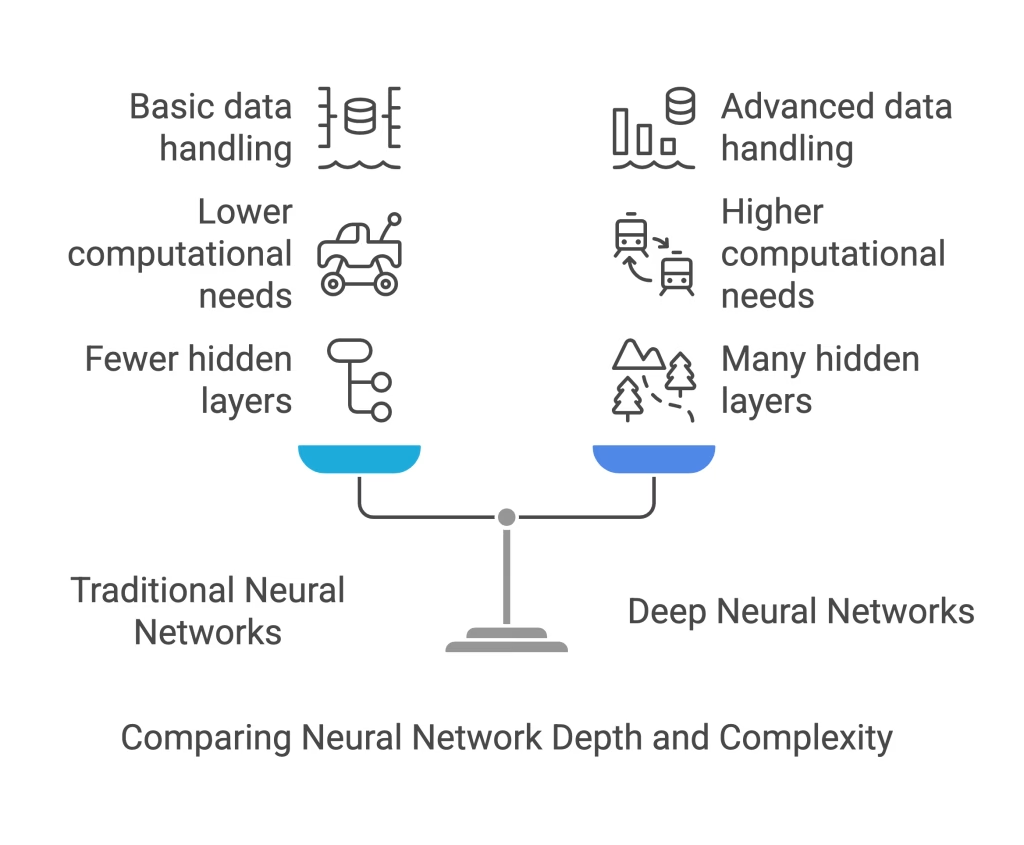
To fully understand the question, “Are neural networks part of deep learning?” it’s important to explore the differences between deep neural networks and traditional neural networks.
Depth of the Network
The primary difference lies in the number of layers. Traditional neural networks typically have one or two hidden layers, while deep neural networks can have dozens or even hundreds of layers. This depth allows DNNs to model complex relationships in data.
Computational Requirements
Deep neural networks require significantly more computational power and data compared to traditional neural networks. Training a DNN often involves using specialized hardware like GPUs or TPUs to handle the massive calculations involved.
Performance and Applications
Deep neural networks outperform traditional neural networks in tasks that involve large datasets and complex patterns. For example, CNNs are widely used in computer vision, while RNNs and their variants (like LSTMs) dominate natural language processing.
Deep Learning Versus Neural Networks: A Practical Perspective
To better understand the relationship between deep learning and neural networks or to answer the question “are neural networks part of deep learning” in a better way, let’s look at some real-world applications.
Image Recognition
Deep learning models, particularly CNNs, have revolutionized image recognition. They can identify objects, faces, and even emotions in images with high accuracy. Traditional neural networks struggle with such tasks due to their limited capacity.
Natural Language Processing (NLP)
Deep learning has transformed NLP by enabling models like GPT and BERT to understand and generate human-like text. These models rely on deep neural networks to process and analyze vast amounts of textual data.
Autonomous Vehicles
Self-driving cars use deep learning to interpret sensor data, recognize obstacles, and make driving decisions. The complexity of these tasks requires the advanced capabilities of deep neural networks.
Why Neural Networks Are Central to Deep Learning
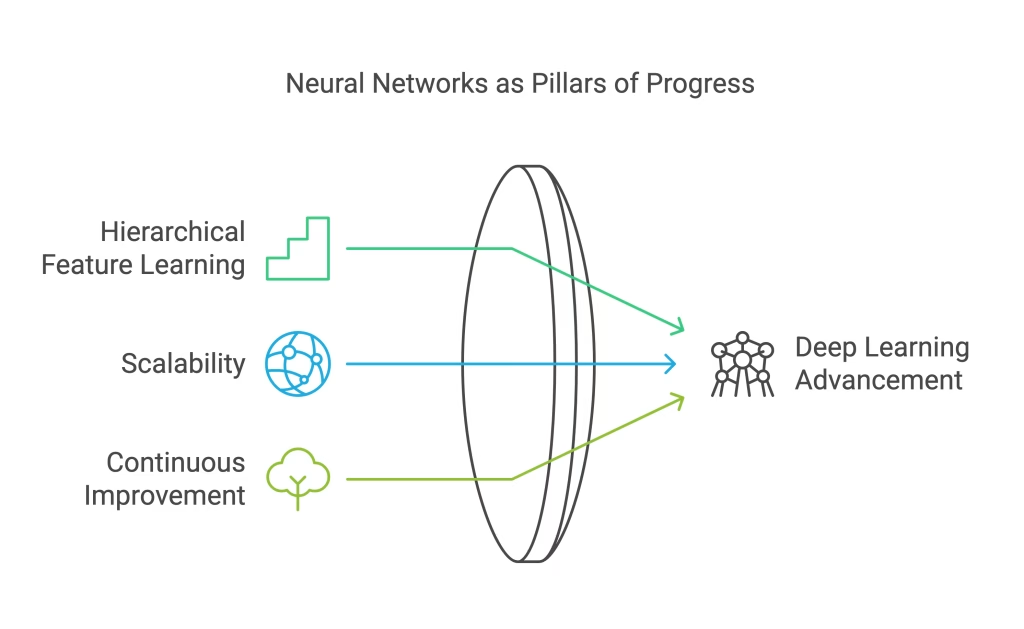
Neural networks are not just a part of deep learning—they are its foundation. Here’s why:
Hierarchical Feature Learning
Deep neural networks excel at learning hierarchical features. For example, in image recognition, early layers might detect edges, while deeper layers identify shapes and objects. This hierarchical learning is a hallmark of deep learning.
Scalability
Deep learning models can scale to handle massive datasets, making them suitable for big data applications. This scalability is made possible by the flexible architecture of neural networks.
Continuous Improvement
As research in neural networks advances, so does deep learning. Innovations like attention mechanisms, transformers, and reinforcement learning are pushing the boundaries of what AI can achieve.
Conclusion: The Inseparable Connection
So, are neural networks part of deep learning? Absolutely. Neural networks provide the structural framework, while deep learning leverages this framework to solve complex problems through deep architectures. Understanding this relationship is key to appreciating the power and potential of modern AI.
Whether you are exploring deep neural networks vs neural networks or delving into the nuances of deep learning versus neural networks, one thing is clear: neural networks are not just part of deep learning—they are its essence. As AI continues to evolve, the synergy between these concepts will drive even more groundbreaking innovations.
How can Beesoul help?
Beesoul has been providing AI based consulting services for more than 5 years. We’ve been able to deliver healthcare apps that is driven with AI, based on data we were able to generate with volunteers. Reach out to us here and we’ll help you with what you’re looking for.

Related articles

How to Create a Personal Website for College Apps Reddit:2025 Guide
Why a Personal Website Matters for College Applications A personal website can be a game-changer for your college application. It...

Top Strategies for a Professional Looking Website, Reddit-Approved:2025
Introduction: Why a Professional-Looking Website Matters? A professional looking website, Reddit users often emphasize, is essential for credibility and success....

Web Design for Small Businesses: The Complete Growth Guide
Introduction In today’s digital world, having a strong online presence is no longer optional, it’s a necessity. For small businesses,...

Ready to Ship Your Vibe Coded App?
You've already done the hard part — validating your idea and building something that works. Let's turn it into a product your users can trust and your business can scale.